As part of Black History Month, we are publishing a series of Q&As giving people from different parts of our club the opportunity to talk about their experiences of football, their relationship with Clapton Community FC, their own histories and identities, and what they would like to see from the club and from football more broadly.
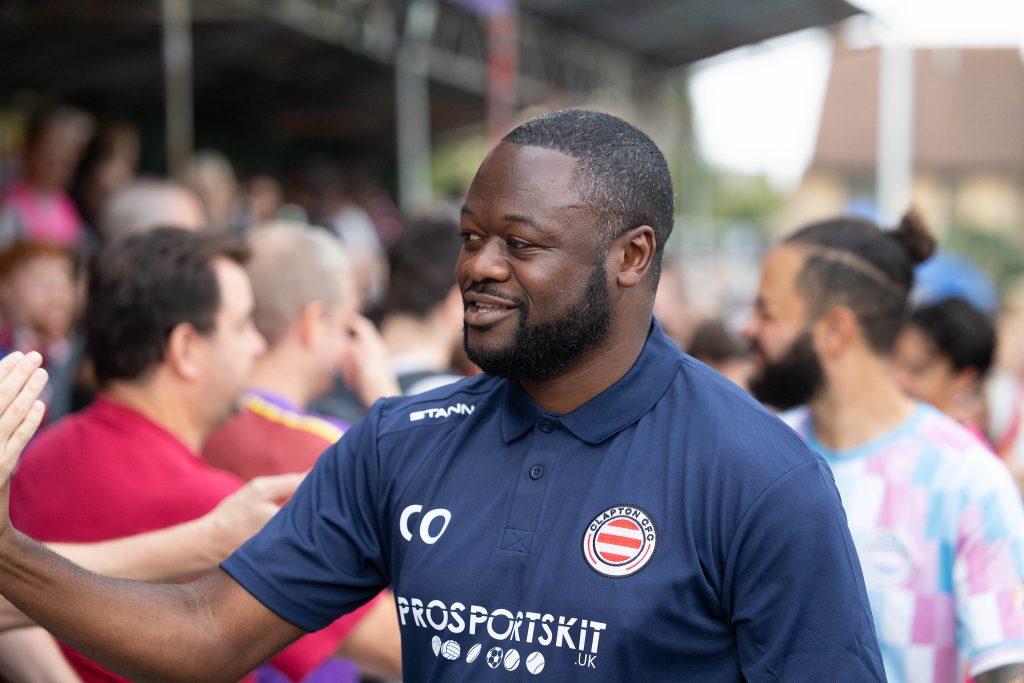
Geoff Ocran needs no introduction to anyone connected to Clapton CFC, having been manager of the Men’s First Team from day one in 2018 and leading the team to three promotions and three cup final wins.
When a club says it is “anti-racist”, what should that actually mean beyond putting out a statement or wearing a T-shirt?
Beyond the T-shirts and the gestures, being anti-racist is having a zero tolerance attitude internally and externally to any issues regarding race.
Do Black players and supporters sometimes feel pressure to let racist comments or behaviour go because they don’t want to be labelled as difficult?
I wouldn’t be surprised if some people felt like that. In a scenario of my word against someone else, without key witnesses then it’s down to the panel’s discretion. I think tolerance for any sort of racial abuse is at its lowest so you should feel comfortable to speak out now. I’ve been fortunate to not experience it personally, but have been on the pitch when it’s happened to a teammate a while back and we just took the law into our own hands, Cantona-esque.
Is having Black players in a team enough to make a football club genuinely inclusive?
Inclusion shouldn’t stop at just having Black players in the team or squad, it should be creating an environment for different backgrounds to be welcomed into the club.
Does football genuinely value Black culture, or does it sometimes value Black players while remaining uncomfortable with Black voices and politics?
Politics will always remain in football as it is a reflection of society on the pitch. Lived experiences of why Black players took the knee should be heard and not challenged as it’s the only way any progress can be made.
What does being a Black supporter/player at Clapton Community FC mean to you? Is the club genuinely different from other football clubs you’ve experienced?
Out of all the clubs I’ve been involved in, Clapton is definitely the most proactive and vocal regarding any race issues. That is internally and externally as we will publicly support any club that have experienced any sort of racial discrimination in football.
Clapton Community FC talks a lot about community, equality and inclusion. Where do you think the club gets it right, and where could it do better?
Walter Tull is a cult hero around these parts which is great to see but maybe we can also create other cult heroes who endured similar racial bigotry over the course of time and champion them also.
Does Black History Month genuinely educate people, or can it sometimes become a month of well-meaning gestures before everything returns to normal in November?
Although I believe Black History Month has good intentions, it can venture into tokenism depending on where you look. The same pictures and captions posted up every year like Christmas decorations.
How important is it for young Black footballers to see people who look like them in positions beyond the pitch?
Having different themes each year shows a bit of thought has gone into it celebrating different aspects of Black culture and history other than slavery. Black scientists and inventors who haven’t been recognised for their work for example can segue into a topic of how important visual black representation is in and outside of football. The next generation will only believe something is possible if they see it visually and have a role model to aspire to especially off the pitch as we know about the demographic of black coaches and managers higher up in the game.
Can someone love football, support a club and still be part of a culture that excludes Black people?
Football is moving in the right direction in terms of intolerance towards bigotry and it will have to be an ongoing educational process.
Is football genuinely prepared to listen to Black people when they say something uncomfortable, or only when they say something that makes everyone feel good?
It all starts with listening to understand and not disregarding lived experiences of Black people on and off the field especially during an era when racism wasn’t challenged in stadiums so players learnt to just get on with it. Other demographics would not have experienced the subtle micro-aggressions that Black people often have to endure so it’s important that they are educated and willing to understand.
What is something white football supporters genuinely don’t understand about being Black in football?
Black History Month should be an avenue to progress the work that is done in football over the year like events such as the Black List Football Awards.
If you could change one thing about football’s relationship with Black people tomorrow, what would you change, and why?
I very much live by the motto of not just asking questions on a soap box pointing fingers but providing solutions and answers to those questions. So for example we took the knee before games but then what next? How do we convert that exposure and awareness into more opportunities for black people higher up the pyramid etc. This is where we can do better as a community as we aim to leave the game more diverse like the Black icons of the game fought before us during the 70s and 80s.