
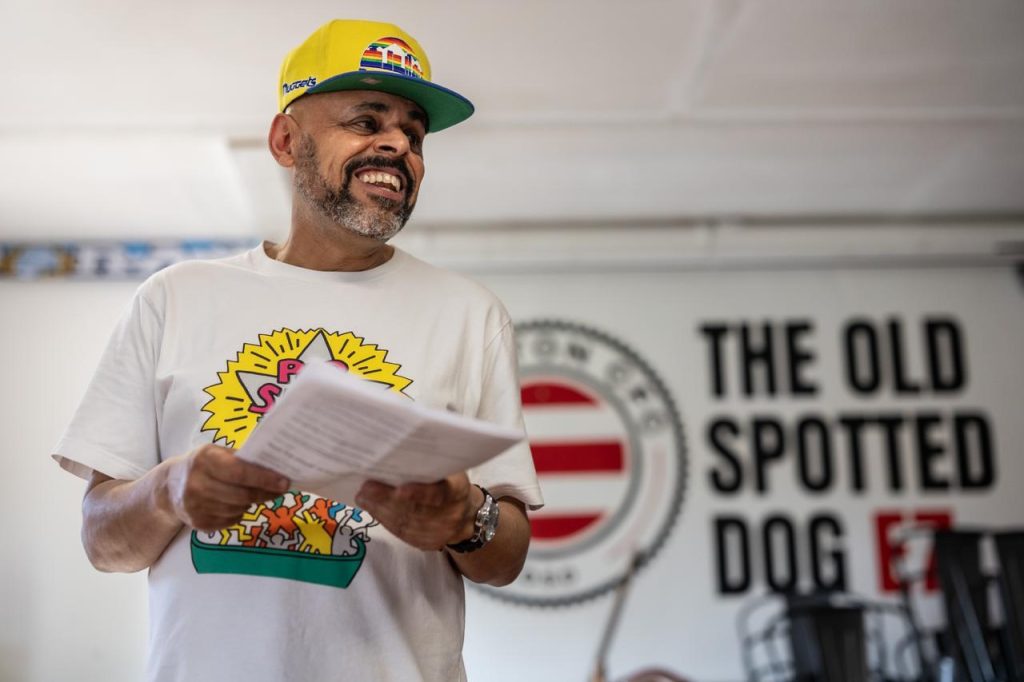
As part of Black History Month, we are publishing a series of Q&As giving people from different parts of our club the opportunity to talk about their experiences of football, their relationship with Clapton Community FC, their own histories and identities, and what they would like to see from the club and from football more broadly.
Ric Prescod has been a volunteer and member at CCFC for 7 years and is the League Representative as well as a member of Merch, Matchday, Membership and the General Organising Committee.
When a club says it is “anti-racist”, what should that actually mean beyond putting out a statement or wearing a T-shirt?
For me, being anti-racist has to be something you actually see in the way a club operates. It can’t just appear when there is a particular incident or when October comes around.
Being anti-racist means challenging racism when it happens, having clear expectations about behaviour and being prepared to have difficult conversations. It also means looking at the structure of the club and asking who has opportunities, who gets heard and who is involved in making decisions.
One of the things I value about CCFC is that because we are a member-owned club, there are opportunities for people to become involved beyond simply watching football. I’m involved through Football Operations and as the club’s League Representative, and that gives me a voice in areas of the club that affect how football is actually run.
For me, that’s part of what anti-racism should mean. Not simply being represented, but having a voice.
Do Black players and supporters sometimes feel pressure to let racist comments or behaviour go because they don’t want to be labelled as difficult?
I think they can. There is sometimes an unspoken pressure to decide whether something is “worth making a fuss about”. You don’t necessarily want to be the person who changes the atmosphere, causes an argument or gets labelled as difficult.
But if you continually let things go because they’re individually “not that serious”, eventually you create an environment where people know they can get away with things.
I’ve always felt that challenging racism shouldn’t be the responsibility of the person experiencing it. If someone else sees something wrong, they should be prepared to say something too.
That’s particularly important in a community club. If we genuinely believe the club belongs to everyone, then everyone has some responsibility for the culture we create.
Is having Black players in a team enough to make a football club genuinely inclusive?
No. It’s an important part of representation, but it isn’t the whole picture.
From my position within Football Operations, I see how much happens away from the actual 90 minutes. There are committees, volunteers, league administration, matchday operations, coaching, safeguarding, ground operations and countless other things that keep a football club functioning.
So I think we have to ask who is involved in those areas as well. A club can have a very diverse playing squad but still have very little diversity among the people making decisions.
For me, inclusion means having the opportunity to participate and having your contribution taken seriously when you do.
Does football genuinely value Black culture, or does it sometimes value Black players while remaining uncomfortable with Black voices and politics?
I think football can be comfortable celebrating Black talent while being less comfortable listening to Black people when the conversation becomes difficult.
We see Black culture everywhere in football. It has influenced the game enormously, from players and playing styles to music, fashion and supporter culture.
But celebrating culture is easier than confronting racism or discussing inequality.
I think there is a danger of saying, “We love our Black players”, while not necessarily wanting to hear what those same people have to say about their experiences.
For me, genuine inclusion means accepting that people don’t stop being political, opinionated or challenging simply because they pull on a football shirt.
What does being a Black supporter and member of Clapton Community FC mean to you? Is the club genuinely different from other football clubs you’ve experienced?
This is probably the question I find most interesting.
My involvement with CCFC isn’t simply as someone who turns up on a matchday. As the League Representative and a member of Football Operations, I get to see some of the less visible side of the club.
What makes CCFC different to me is that there is an attempt to give ordinary members an actual stake in the organisation. You can get involved. You can put forward proposals. You can volunteer. You can join a committee. You can challenge something you don’t agree with.
That doesn’t mean we’re perfect. Far from it. But I think there is a fundamental difference between being a customer of a football club and being part of a football club. CCFC gives me the opportunity to be part of it.
As a Black member, that matters to me because representation isn’t just about seeing someone who looks like you on the pitch. It’s about knowing that you can occupy space within the organisation and have something meaningful to contribute.
Clapton Community FC talks a lot about community, equality and inclusion. Where do you think the club gets it right, and where could it do better?
I think the club gets it right in understanding that football isn’t just about the men’s first team.
The youth section, women’s football, Open Access, volunteers, community activities and supporter groups all contribute to what CCFC is.
I also think our ownership model gives people an opportunity to participate in the running of the club that they don’t necessarily get elsewhere.
But I don’t think we should congratulate ourselves too much. If we’re serious about being a community club, we should continually ask ourselves who isn’t participating and why.
Are there people who feel the club isn’t for them? Are there barriers to volunteering? Do people feel confident putting themselves forward? Are we hearing enough different voices when decisions are made?
Being inclusive isn’t a destination. It’s something you have to keep working at.
What responsibility does a community-owned club have to challenge racism beyond its own teams?
Quite a lot, actually. We’re based in Forest Gate, and we’re surrounded by a community with a huge amount of cultural and ethnic diversity. We’re not an isolated football club that happens to have an address here.
Our youth players, families, supporters and volunteers come from the local community. That gives us an opportunity to use football to bring people together, but also to create conversations about things that affect the community.
I don’t think CCFC can solve racism. That’s far bigger than any football club. But we can decide what behaviour we accept, what opportunities we provide and whether we are prepared to speak when something isn’t right.
For me, that’s part of what being community-owned should mean.
Does Black History Month genuinely educate people, or can it sometimes become a month of well-meaning gestures before everything returns to normal in November?
It can certainly become that. You can have a month full of social media posts, posters and events, and then on 1 November everything disappears.
But I don’t think that means Black History Month isn’t valuable. The problem is when organisations treat October as their annual opportunity to demonstrate that they aren’t racist, rather than using it as an opportunity to examine what they actually do.
For CCFC, I’d rather Black History Month started conversations that continue after October.
How important is it for young Black footballers to see people who look like them in positions beyond the pitch?
Extremely important. A young Black player shouldn’t have to think that their only possible future in football is as a player. They should be able to see themselves as a coach, referee, administrator, journalist, physiotherapist, committee member or even running a football club.
That’s one of the reasons I think my own involvement with Football Operations is important. I’m not suggesting I’m some great example of representation. I’m simply saying that being able to see people from different backgrounds involved in the running of football helps demonstrate that those spaces are available to you too.
Representation isn’t just about inspiration. It’s about making possibilities visible.
Can someone love football, support a club and still be part of a culture that excludes Black people?
Yes. Loving football doesn’t automatically make someone free from prejudice.
Someone can passionately support a club and still tolerate racist behaviour, repeat stereotypes or fail to recognise the experiences of Black supporters and players.
That’s why football clubs need standards.Supporting a club shouldn’t mean switching off your responsibility towards other people.
If we believe football belongs to everyone, then how we behave towards other people has to be part of what being a supporter means.
Is football genuinely prepared to listen to Black people when they say something uncomfortable, or only when they say something that makes everyone feel good?
I think this is one of the biggest tests. It’s easy to listen when someone tells you that you’re doing a good job. It’s much harder when someone says, “Actually, you’ve got this wrong.”
I’ve experienced enough of football administration to know that sometimes the most useful conversations are the uncomfortable ones.
Within CCFC, I think being member-owned gives us a mechanism to have those conversations. Members can raise issues, make proposals and challenge the direction of the club. We shouldn’t be frightened of that.
If somebody raises an uncomfortable point about race or inclusion, the first response shouldn’t be defensiveness. It should be to listen and ask whether there is something we need to learn.
What is something white football supporters genuinely don’t understand about being Black in football?
I wouldn’t want to pretend I can speak for every Black person in football because everyone’s experiences are different.
But I think one thing that can be difficult to understand if you’ve never experienced it yourself is the cumulative effect of small things.
It isn’t necessarily one huge racist incident. It can be the assumption someone makes about you, the comment that is dismissed as a joke, the feeling that you have to decide whether something is worth challenging, or simply being aware that you’re sometimes being viewed through the lens of your race.
One incident might be easy to dismiss. Years of small incidents are something else.
I think the most useful thing white supporters can do isn’t necessarily to try to understand exactly what being Black feels like. It’s to listen when Black people tell them about their experiences and not immediately look for a reason to explain them away.
If you could change one thing about football’s relationship with Black people tomorrow, what would you change, and why?
I’d change the idea that representation is the finish line. Football is very good at celebrating Black players when they are successful on the pitch. I’d like us to be equally interested in who gets opportunities to influence football away from the pitch.
Who becomes a coach? Who becomes an administrator? Who gets onto committees? Who becomes a club secretary, CEO, chair or owner? Who gets listened to when decisions are made?
And I’d like football to become better at challenging racism collectively. It shouldn’t always be the Black person who has to point out that something is racist. If someone sees it, they should challenge it.
For me, that’s ultimately what inclusion means. Not simply inviting people into the room, but making sure they have an equal opportunity to speak, participate and help decide what happens next.
And that’s something I think a community-owned club like CCFC has a particular opportunity to demonstrate.