“Entá tenemos el corazón na xornada que vivimos el sábadu en La Cruz”
(UC Ceares website)
By Friday evening, July 3, 2026, Clapton CFC players and fans had arrived in Asturias by several different routes. Some came through Santander, others through Bilbao or Oviedo, and others from Madrid, San Sebastián and elsewhere in Spain, by air, road or even ferry. By the time people began finding each other in Gijón/Xixón, the tour had already started.
For anyone in a hurry, the trip can be summarised like this: we enjoyed ourselves, won both matches, made some friends and learned something about the people, clubs and city that hosted us. Then we came home without any dramas. For the longer version, read on.
Friday: arrivals and first meetings
Summer tours are now part of Clapton CFC’s rhythm, and Spain has become a familiar stop. This was our third visit since 2018. This time the invitation came from UC Ceares in Gijón/Xixón, where both first teams would face local opposition at Campo de La Cruz: the women against CF Llosalín, who had travelled from La Ribera near Oviedo, and the men against UC Ceares.
The tour had been arranged in a hurry. Details appeared in the weekly members’ newsletter, although a few only discovered it was happening when someone mentioned it in passing. Getting there brought another complication. Flights to Asturias were far less plentiful than flights to Madrid, and the direct options tended to leave at the least convenient times. Clapton CFC members have become used to jumping hurdles, and people began piecing together routes of their own.
Some gave themselves a head start, flying into Santander or Bilbao on Thursday and using the spare day well. Others flew to Oviedo and took the short Alsa bus to Gijón/Xixón, a simple trip that drops you in the centre. In Santander, the extra day meant riding the pasillos rodantes inclinados, the city’s inclined travelators and a small attraction in their own right, eating well and exploring a city compact enough to cover entirely on foot.
The reward came the next morning: an unhurried walk to the bus station and the scenic Alsa journey to Gijón/Xixón in daylight. The road ran through green, mountainous scenery that reminded several of us of North Wales. Asturias has that blend of coast, hills and weather that puts you in two places at once, familiar and different at the same time, and always shifting as you move through it.
The players, arriving along the same route on Friday evening, had no such luck. Most flew to Santander, where a chartered bus was waiting to take them on the three-and-a-half-hour journey to their hotel. By then the sun had gone down and the mountains everyone else had admired passed by unseen. Supporters continued to arrive by whichever routes worked, including one couple already holidaying in Alicante who flew north to Oviedo for the long weekend.
Gijón/Xixón turned out to be the right size for this sort of weekend. It is Asturias’ biggest city, but compact and walkable, with a relaxed feel, a historic old town and a long golden beach facing the Cantabrian Sea. Asturias sits between Cantabria to the east, Castile and León to the south and Galicia to the west, with the Cantabrian Mountains forming a natural barrier inland. The region has its own strong identity, and that was present throughout the weekend.
For a club still far closer to park football than professional football, there was something quietly remarkable about Clapton CFC supporters arriving from all over Spain and finding each other in Asturias. Some were long-standing members. Some were newer members taking a punt on their first overseas tour with Clapton CFC. Others lived in Spain and had made their way from Madrid, Bilbao, San Sebastián and beyond, proudly letting us know they were owners too and showing their membership cards.
It was unexpectedly moving. Ownership felt less like a constitutional arrangement and more like something lived, with members travelling hundreds of miles to support a club and meeting each other in a place of their choosing.
Right from the start, it was clear UC Ceares had put thought into almost every part of the visit. Our ‘Gijón trip’ Telegram group shared information, locations and venues as people arrived. By Friday evening, Páramo Bar had become the first gathering point.
The venue was not large, and UC Ceares had limited their own official presence to three people. Clapton fans, along with the players who had arrived earlier, filled the place. It was a good evening, and some older members made sure they left after our hosts, by quite a distance.
The main player group arrived in Gijón/Xixón around midnight, too late to make the bar, although even some of them stayed up for the start of the 3am Ghana World Cup match. All those years of training and experience were about to be tested in a different way: making the 11am meeting the following morning.
Saturday morning walking tour
Saturday, 4 July began with a challenge. After the festivities of Friday night, UC Ceares had arranged an 11am meeting at the highest point on the coast, overlooking the city and the beach. At first, that seemed optimistic. Gradually, though, the numbers grew. Supporters and players gathered for a walking tour through Gijón/Xixón’s political history, beginning with the prelude to the Spanish Civil War and ending at the cemetery that holds its memory.
For a club whose away kit is modelled on the flag of the Second Spanish Republic, in tribute to the International Brigades, much of what we were about to hear would carry an immediate resonance.
The tour opened with the Asturian Revolution of 1934. Miners and workers rose in October after CEDA entered government. A strike turned into an armed uprising, and workers held parts of Asturias, including areas around Oviedo. The Republic sent in troops, including colonial units, and the revolt was crushed, with heavy repression afterwards. For Asturians, 1934 is not a remote event. It sits beneath what came next.
Our guide, Xose, accompanied by friends, then moved to a question that had puzzled some of us. Why were there so many Argentines in Gijón/Xixón watching the World Cup match? The answer took us back to the Civil War. Many people left from the port of Gijón/Xixón for exile in South America, carrying with them family histories shaped by defeat, flight and memory.
From there we walked steadily down into the city, through the old town, stopping at buildings whose façades concealed heavier stories. We learned of Gijón/Xixón as the most bombed city on the Northern Front during the Civil War, with hundreds of days of bombardment, including attacks by the Condor Legion. We heard how the nationalist navy shelled the city and how, in one incident, it ended up bombing its own side. Beneath the streets, air raid shelters spread through the city and became refuges for civilians facing the terror from above.
The tour brought home the daily reality of war: food shortages, power cuts, disrupted schooling and the constant threat of bombing. The violence did not end with the formal close of the conflict. Xose spoke of the revenge that followed and the long effort to break the left after the fall of the Second Republic.
We also heard about the division between the cities of Oviedo and Gijón/Xixón. Oviedo sided with the nationalists. Gijón/Xixón remained a strongly Republican city. The tension between the two places has not entirely disappeared as our guide frequently reminded us.
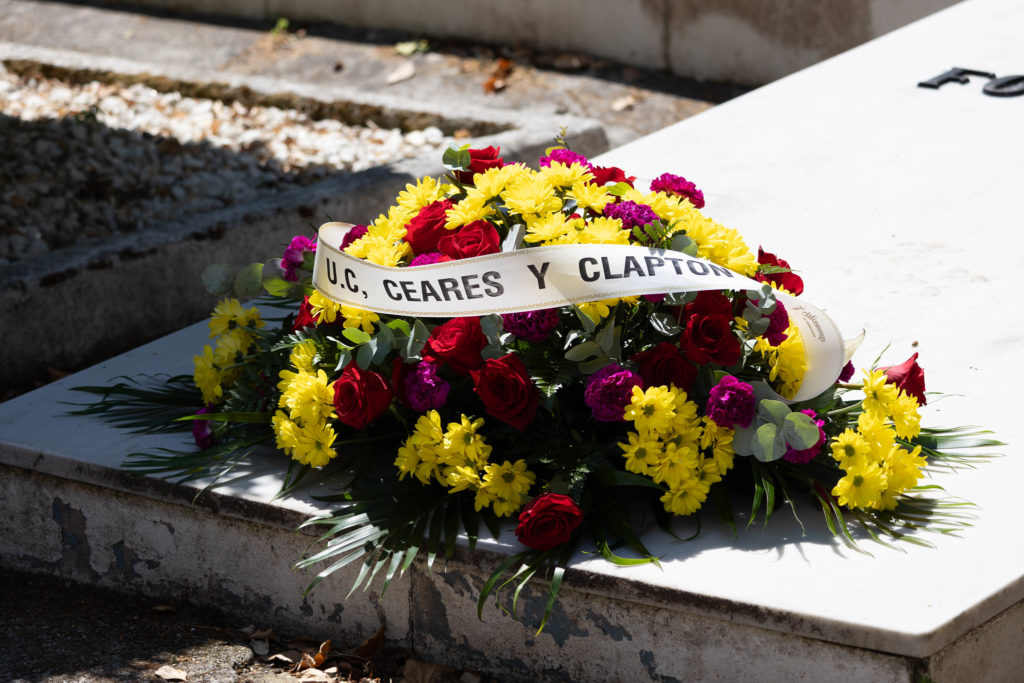
The hardest stop came at Cementerio de Ceares, El Sucu. UC Ceares had bought a wreath of red, yellow and purple flowers for the occasion and asked Clapton CFC to lay it. We hadn’t expected it. The mood changed without anyone saying anything. The chatter that had followed us down the hill faded away. Some people took photographs. Others didn’t. Most of us simply stood in front of the plaques, reading the names. For a few minutes, nobody seemed in a hurry to move on.
Daniel, a Clapton supporter and author on Civil War memorials, had travelled from Madrid and spoke about the meaning of these memorials. Most of the memorials were paid for by families without state support. They were acts of memory by people who refused to let their relatives and comrades disappear into silence.
We were shown a memorial listing hundreds of names. Around it, families had remembered loved ones whose lives had been cut short. This was not our city and not our history to claim, but the members of UC Ceares had brought us into that space as comrades and guests. People stood quietly. There was not much to add.
Football, friendship and a long Saturday night
The silence at El Sucu was not the end of the day. We walked the short distance to Campo de La Cruz, the home of UC Ceares. The ground is municipally owned, as are many football grounds in Spain. Cemetery, neighbourhood, football ground, memory and community sit close together.
We had already spent several hours with people from UC Ceares and were beginning to understand the club we were visiting. UC Ceares is a neighbourhood club from Ciares/Ceares in Gijón/Xixón. Its roots go back to the years after the Second World War, when two clubs merged to form Unión Club de Ceares, and it adopted the red and blue colours in 1948. In January 1978, it moved to its current ground, La Cruz, on land ceded by neighbours and developed through the work of socios and directors.
The more recent history helps us understand why the invitation made sense. In 2011, after an old board considered leaving or merging elsewhere, former players, socios and neighbours took over and began building a new assembly-led model. They rejected fútbol negocio, in our terms, ‘Against Modern Football’, and turned back towards popular, social football. Members have voted on budgets, accounts, ticket prices, the canteen and social policy. The club has built neighbourhood links, food and school-material collections, cultural projects, support for women’s football and solidarity with local associations.
CF Llosalín have their own history. Based in La Ribera, near Oviedo, the club are an independent women’s side founded in 2000 and have spent the last quarter century helping develop women’s football in Asturias. They have a strong public voice reflecting the culture around the club: women’s football, the Asturian language, LGBTQ+ rights and local social causes. Like UC Ceares, they are tied to the place around them.
The same attention went into the fixtures. UC Ceares’ women’s team had just won the Asturian title and play at a much higher level, so CF Llosalín stepped in to make the game work. For the men’s match, UC Ceares included several youth players. These were friendlies, and our hosts did all they could to create games worth playing rather than manufacture easy wins, in keeping with the spirit between the three clubs.
UC Ceares’ generosity extended well beyond organising the fixtures. They donated half of the gate receipts from an attendance of roughly 400 to 450.
The football began in heat that was more manageable than it first looked. The temperature had risen to around 30 degrees on Saturday, after more comfortable days of around 24, but without the heavy humidity that can make that sort of heat feel worse. It was hot, though not at Vallecas levels.
By then, the away shirts had already drawn plenty of interest. Requests had come in as soon as the tour was announced, and the small stock taken out to Asturias sold quickly, even without the professionalism of our matchday setup. A few people bought UC Ceares shirts, including one member who somehow walked away with a Ceares number nine shirt and only realised the good fortune the next day.
Clapton produced a custom pennant for each match. Nothing was left to chance. Two members rehearsed the handovers with forensic care, recalling the televised version frame by frame, just in case the fans were unexpectedly called upon to uphold the club’s dignity.
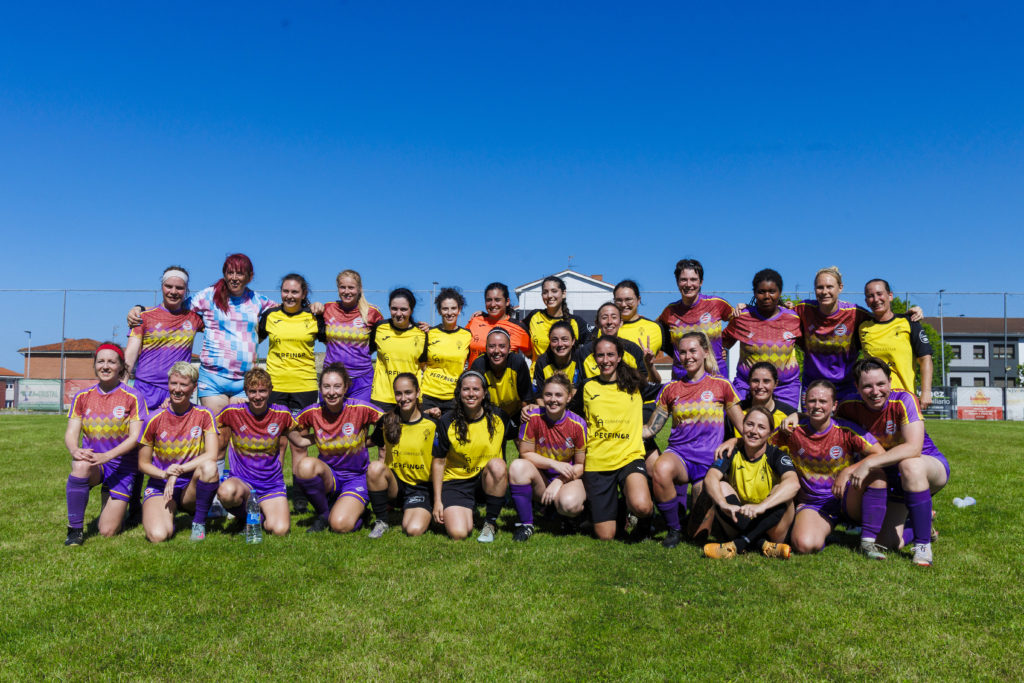
After the captains exchanged pennants, the women’s match against CF Llosalín kicked off at 4pm. The game was even at first. Llosalín began brightly and it had a competitive feel, but Clapton gradually took control of possession and territory. The pressure eventually told, with Clapton going on to win 3-0.

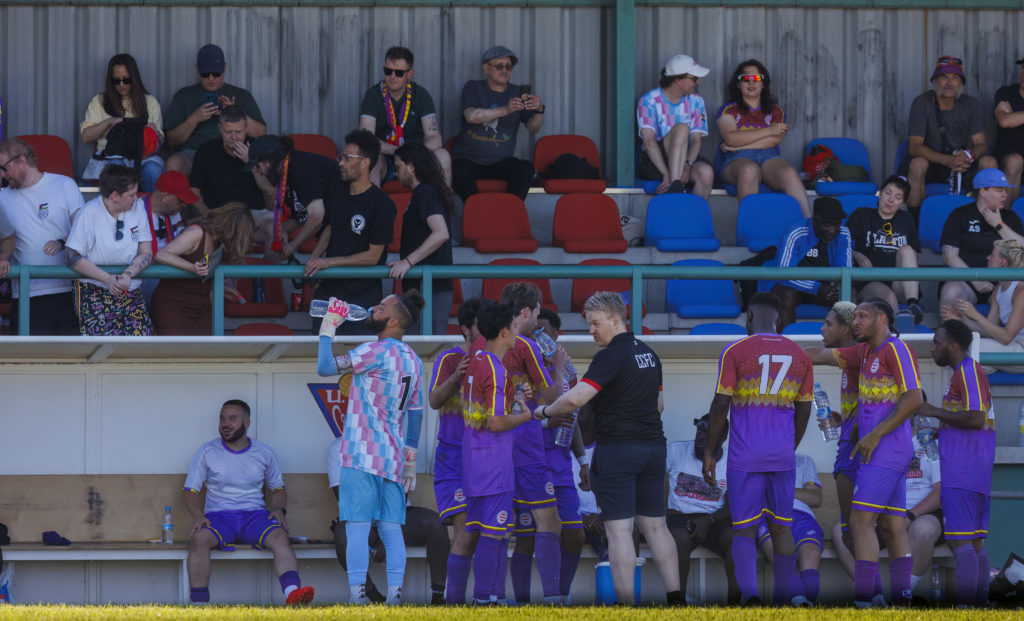
The match was played in a fine spirit and afterwards the two teams mixed together. Clapton’s traditional Lo-Los celebration between players and fans followed in front of the section of the seated stand where most Clapton supporters had gathered. It was one of those small tour moments that will probably be remembered more fondly than any single passage of play.
The pennant ceremony was repeated before the men’s match kicked off at 6.30pm. Clapton players later commented on their opponents’ possession-heavy approach. Ceares’ patience on the ball drew comparisons with Ocranball, a term that will mean entirely different things depending on which Clapton member you ask. As in the women’s match, Clapton gradually imposed themselves territorially, even if not always through possession, and eventually won 4-0. Cue the celebrations.
During the match, a couple of Clapton members asked the UC ultras whether Clapton supporters could join their home end afterwards. Agreement was reached, scarves were exchanged and the two sets of supporters joined in the Lo-Los together. At one point, one fan even uncoupled his prosthetic leg and waved it above his head.
As the celebrations came to an end, Geoff, the CCFC Men’s First Team manager, gave a short speech thanking UC Ceares and everyone who had helped make the weekend possible. He also reminded the players that pre-season had now officially begun. By then, the home end had shifted from a place we had been invited into to a space we could share.

UC Ceares then laid on a DJ, playing a mix of reggae and ska. People who had been strangers the day before were still talking long after the match had finished. Drinks were shared. Scarves were compared. The day could, and for some should, have ended there. It did not.
Our hosts then took those still at the clubhouse to a nightclub. It was past midnight, but the night carried on. Some of the players came too, adding to the sense that this was one club trip rather than two parallel tours.
Sunday and what stayed with us
By Sunday, it felt as though we had been in Gijón/Xixón for much longer than two days. One member put it down to the way time slows when you are in the middle of learning and absorbing new experiences. Friday already felt some distance away, although the lack of sleep may also have contributed.
Sunday was a recovery day for some and another full day in Gijón/Xixón for others. Some travelled home. Others went to the beach. Some of the players hired electric scooters for an impromptu tour of the seafront.
Some of us developed a taste for the local sidra, poured in the traditional Asturian way from a bottle held high into a glass held low. Maybe it was the weather, maybe the day itself, but once people started, they rarely stopped at one bottle.
Across the city, it was odd and pleasing to spot Claptonites in small groups, drifting through streets, cafés and seafront spaces as if the club had briefly scattered around the city.
On Sunday evening, our UC Ceares hosts invited us to a fairground near the docks. It really was a fairground, but also much more: a huge left-wing book fair, food stalls, music, conversations and the feel of an annual festival rooted in local political culture. We had just entered the Feria de Asociaciones y Movimientos Sociales, an event organised by grassroots groups which none of us had managed to find listed online.
It was also a moment when the anxiety lifted. One UC Ceares member admitted they had been nervous beforehand, unsure whether two clubs who knew each other largely through messages and social media would connect. By then, the question had answered itself.
We were told that next year UC Ceares would be showing a film about our visit. As the farce of the World Cup played in the background, members of two grassroots football clubs sat around talking about what clubs like ours might learn from each other.
These trips can look unusual from the outside. After all, how many clubs with a tier 6 women’s team and tier 9 men’s team have a summer tour led by the members who own it? Once you are there, they make perfect sense.
The weekend was a collective effort, but a special mention must go to our hosts, Xose, Raoul and Íñigo. In bars, at the ground, on the tour and at the festival, people gave us their time. Many people commented on how chilled Gijón/Xixón felt as a city, but that feeling came partly from those who hosted us, walked with us and kept opening doors. That leaves an impression.
We should also thank the small group from Clapton who arranged the tour, including the member who organised the players’ travel and accommodation. They secured a block booking on a scheduled flight, arranged the coaches and sorted the hotel. A family occasion prevented them from joining the group, but much of the weekend rested on work they had already done. There were remarkably few dramas across the trip. No one lost a passport, no one was left without accommodation and, as far as we know, nobody missed their flight home.
Not everyone left with the main group on Sunday evening. A few stayed on through the fairground, which meant a third late night in three days, and caught a late-morning Alsa back to Santander or, for some, onwards to Bilbao the following day.
The journey home happened much as the journey out had, scattered across Spain and beyond.
A Clapton member put it well: “I’ve been on holiday abroad where we barely spoke to anyone who lived there. We came here for three days and left with friends.”
The tiredness arrived quickly. The weekend took a little longer to leave.
Through UC Ceares and CF Llosalín, we encountered clubs shaped by neighbourhoods, language, women’s football, member involvement, solidarity and resistance to commercial football.
CF Llosalín put it this way in a Facebook post after Saturday’s matches: “equipos para los que, como nós, el fútbol nun ye nunca solamente fútbol” (teams for which, like us, football is never just football).
If there was any doubt about how seriously our hosts had taken the visit, it disappeared when UC Ceares posted afterwards: “Our hearts are still in the day we lived on Saturday at La Cruz.”
That was our weekend in Asturias.